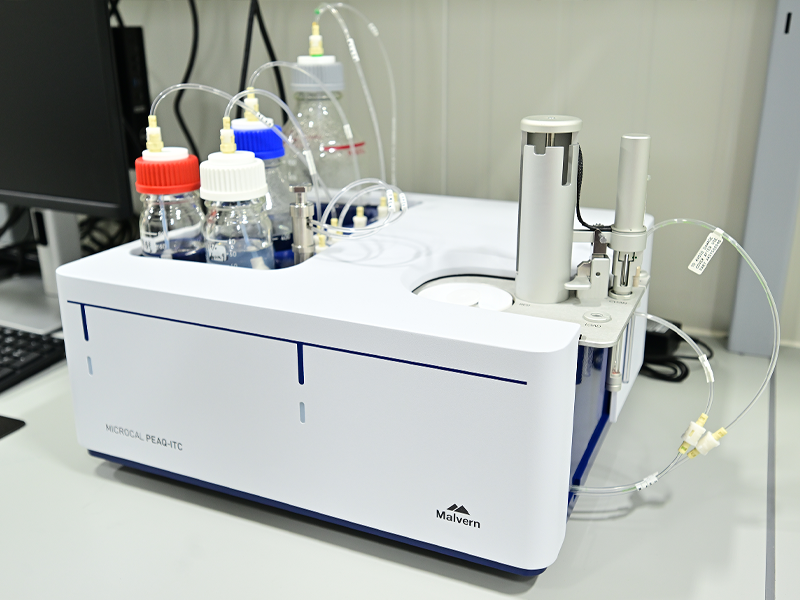
string(16) "en/equipment/702" Isothermal Titration Calorimetry-Shenzhen Medical Academy of Research and Translation
Isothermal Titration Calorimetry

Isothermal Titration Calorimetry

Brand:

Malvern

Model:

Microcal PEAQ-ITC

Affiliated Platform:

Sample Preparation and Analysis Core Facility

Placement:

Weiguang Life Science Park 1A Building 308

Contact Person:

Zhang Jing,Lin Xuezhen

Phone:

15019899679,15625063726

Email:

1. Calorimetry mode: Power compensation method.

2. Noise level under low feedback mode not exceeding 0.63nW.

3. Temperature control range: 2°C-80°C.

4. Response time: Not exceeding 10 seconds.

5. Sample cell material: Hastelloy nickel alloy.

6. Stirring rate: Adjustable within the range of at least 500rpm-1500rpm.

7. Sample cell design: Coin-shaped, fixed type.

8. Titrator volume ≤45μl, with automatic titration and stirring function.

9. Sample cell volume: ≤200μl.

10. Actual sample consumption ≤280μl.

11. Rapid temperature equilibrium time: ≤6 minutes.

12. Heat signal response mode: Three heat signal response modes can be selected through control software.

13. Affinity KA detection range: At least covering 10E2~10E12/Mol, or KD detection range: At least covering 10E-2~10E-12Mol.

14. At least includes data directly obtained from a single experiment: KD, ΔH, ΔS, n.

15. With independent sample cell and titrator cleaning unit: The operating software embeds preset fully automatic cleaning programs, completing descaling agent high-temperature soaking, descaling agent rinsing, water rinsing, methanol rinsing, drying, etc., fully automatically and continuously.

Isothermal Titration Calorimetry (ITC) is an instrument that directly measures the heat released or absorbed during the binding process of biomolecules. By measuring the heat, it accurately determines the interactions between sample molecules and another large molecule, ligand (binding studies), or matrix (kinetic studies), providing precise values for binding constants (KB/KD), reaction stoichiometry (n), entropy change (ΔS), and enthalpy change (ΔH). In a single experiment, it can provide a complete set of information regarding molecular interactions.

Message