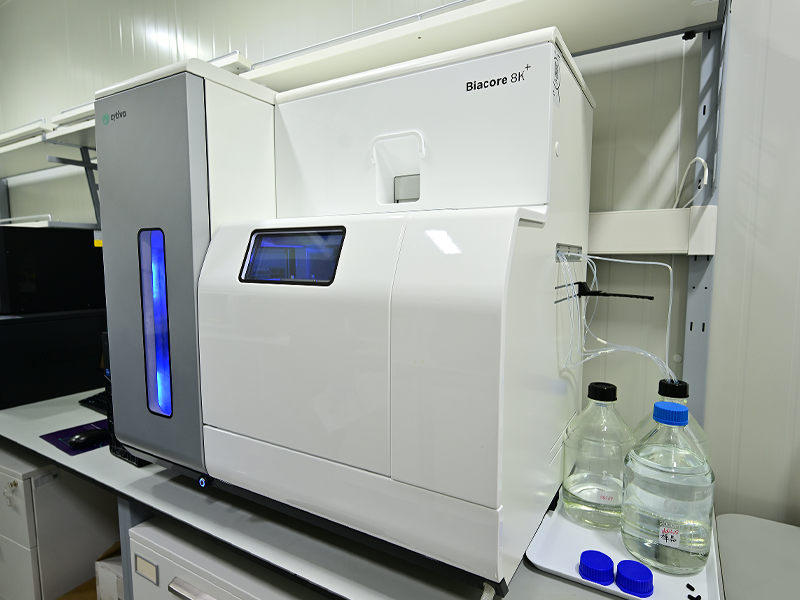
1. Biacore 8K+ Detection Principle: The detection technology is based on surface plasmon resonance (SPR). Baseline noise:<0.02 RU (RMS).
2. Detection Range: biomolecules such as proteins, peptides, antigens/antibodies, nucleic acids (DNA, RNA), lipids, polysaccharides, as well as small molecular compounds, organic small molecules, cells, bacteria, viruses, liposomes, etc.
3. Association Rate Constant (ka): Covers 10^3 to 10^9 M^-1 s^-1.
4. Dissociation Rate Constant (kd): Covers 10^-6 to 0.5 s^-1.
5. Affinity (KD): 10^-3 to 10^-15 M.
6. Response Signal Dynamic Range: Covers 1-70000 RU.
7. Baseline Drift: < 0.03 RU/min.
8. Minimum Sample Detection Volume: 1 μl.
9. Built-in automatic sampler for fully automated sample loading and injection.
10. Automatic temperature control with a temperature range of 4-40°C and optimal temperature control accuracy.
11. Automatic online solution degassing.
12. Automatic online background subtraction.
13. 72 hours unattended automatic operation.
14. 8 sample injection needles, 16 detection channels, capable of simultaneously detecting 8 different interactions.
15. Sample chamber can accommodate 12 microplates, allowing for the simultaneous placement of at least 1-4608 samples.
16. Chip surface reaction temperature control with a range of 4-40°C and temperature control accuracy of 3×10^-3°C.
17. Sensor chips can be regenerated multiple times, with a repeat count of 100 times.
18. Software technical indicators:
18.1 Real-time detection and data acquisition, with the ability to freely set parameters such as injection time, injection position, flow rate, flow path, etc. Can display sample names, types, volumes in real-time, enable continuous flow control, and automatically subtract background.
18.2 Modular and batch analysis of kinetics, concentration determination, screening results, allowing for the free selection of analysis and fitting modes, and automatic fitting analysis. Data analysis results support multiple output formats such as Excel, JPEG, etc., and can be directly imported into other professional data analysis software.
18.3 Conduct dynamic and affinity screening data analysis, fitting analysis, with multiple fitting models to choose from, including but not limited to: 1:1 model; Bivalent model (specific to antibodies), Heterogeneous ligand (polymer analysis), Heterogeneous Analyte (polymer analysis), Two-state (cooperative effect).
18.4 Perform solvent correction analysis, able to set reference or control channels, and automatically subtract background and/or correction coefficients.
18.5 Equipped with an intelligent data quality evaluation system, capable of graphically displaying evaluation results. Can automatically conduct statistical analysis on results and provide corresponding parameters.
18.6 Automatically conduct PLA, EC50, IC50, and potency identification tests.
 Return to Main Site
 Search
 中文
中文



 中文
中文






 Message