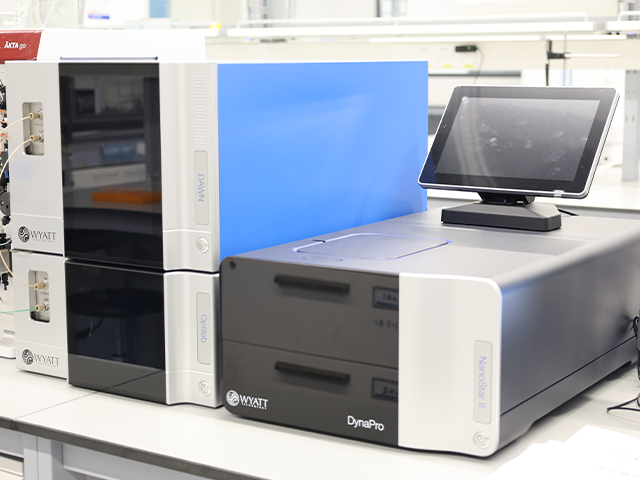
1. Multi-angle static laser light scattering instrument main unit
1.1 It is equipped with 18 photoelectric diodes with detection angles.
1.2 Detector Type: Ultra-quiet Hybrid Photodiode.
1.3 The laser source is a 658nm linearly polarized laser.
1.4 The testing pool is equipped with ultrasonic cleaning device and is made of fused quartz.
2. Interference type differential refraction detector
2.1 Detector type: Diode array technology with 512 diodes.
2.2 The detection wavelength was 658nm.
2.3 It has the function of independent determination of differential refractive index increment (DN/DC value).
3. Dynamic laser light scattering detector
3.1 Multi-mode fiber technology: more abundant light scattering information, to ensure the reliability and stability of the sample detection results with weak scattered signals.
3.2 Double detector technique: that is, the hydromechanical radius Rh and its distribution are measured, and the weight average molecular weight Mw is measured at the same time.
3.3 The laser wavelength is 658nm.
This device is compatible with HPLC/FPLC systems to separate macromolecules with a size range of 1 nm to 1,000 nm, while also equipped with an online multi-angle dynamic and static laser light scattering technology for real-time detection. The detection process maintains the natural structure of the sample, making it suitable for a wide range of research subjects across various disciplines and fields, including proteins, membrane proteins, polysaccharides, peptides, oligonucleotides, nucleic acid vaccines, viruses/viroids, synthetic high molecules, and supramolecular compounds. This enables the analysis and characterization of important information about macromolecule solutions, including absolute molecular weight and its distribution, root-mean-square radius/hydrodynamic radius and its distribution, second virial coefficient, solution conformation (rod-like, random coil, spherical), oligomeric state, sample solubility uniformity, protein stability analysis, homogeneity analysis, binding state, branching degree, and branching unit number analysis, etc.
 Return to Main Site
 Search
 中文
中文



 中文
中文






 Message