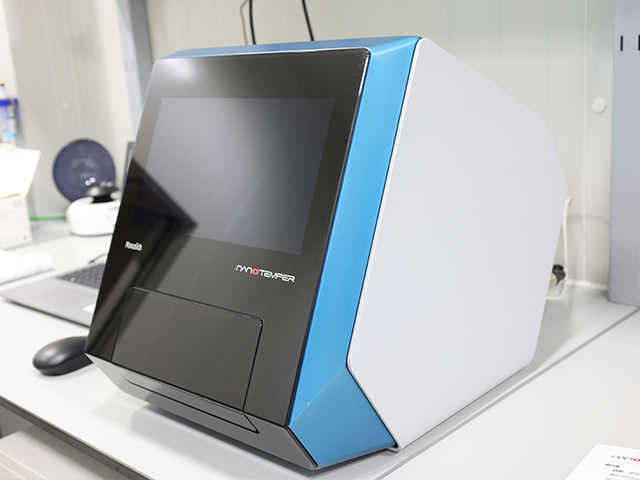
MicroScale Thermophoresis
NanoTemper
Monolith
Sample Preparation and Analysis Core Facility
Weiguang Life Science Park 1A Building 308A
Zhou Yingxin, Xie Xingqiao
15019899679,13671959351
zhouyingxin@smart.org.cn,xiexingqiao@smart.org.cn

string(16) "en/equipment/707"
Welcome to SMART Core Facility
NanoTemper
Monolith
Sample Preparation and Analysis Core Facility
Weiguang Life Science Park 1A Building 308A
Zhou Yingxin, Xie Xingqiao
15019899679,13671959351
zhouyingxin@smart.org.cn,xiexingqiao@smart.org.cn

1. Detection principle: Analysis technique based on micro thermodynamic principle.
2. Affinity detection (KD value) range: pM-mM.
3. Active temperature control function, sample temperature control range: 20℃-40 ℃, temperature control accuracy ±0.5℃.
4. Types of fluorescence channels: Equipped with PicoRed and NanoBlue double fluorescence detection channels, they can detect common fluorescent molecules (Cy3, Cy5, etc.) and fluorescent proteins (GFP, etc.).
5. Affinity can be directly determined in complex solutions such as cell lysate or serum, regardless of buffer composition (such as high concentration organic solvents); It can be detected directly in a liquid environment, ensuring that the samples interact freely under natural conditions, without the need to attach the samples to the biosensor or the chip surface.
6. Quality control function, real-time monitoring of sample quality information and feedback optimization suggestions.
8. Sample types: protein, antibody, peptide, nucleic acid, polysaccharide, small molecule, ion, complex system samples (including serum medium, containing DMSO buffer, cell lysate, etc.).
The instrument is mainly used for qualitative and quantitative detection of biological samples, and its main functions include: light absorption detection, full-wavelength spectral scanning, fluorescence intensity detection, fluorescence polarization, fluorescence resonance energy transfer, chemiluminescence detection, multicolor luminescence scanning, etc.