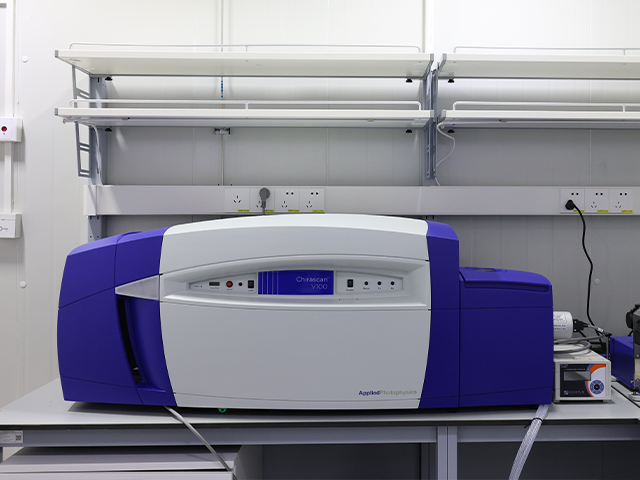
Circular Dichroism (CD) Module
Light Source: 150W Xenon lamp
Spectral Dispersion Principle: Dual-polarization prism method
Effective Detection Wavelength Range: 175 nm - 1200 nm, single detector, no switching required
Wavelength Accuracy: ±0.1 nm (160-500 nm); ±0.5 nm (500-1200 nm)
Wavelength Repeatability: ±0.05 nm (160-500 nm); ±0.1 nm (501-1200 nm)
Wavelength Resolution: 0.01 nm
Stray Light: < 3 ppm (200 nm)
CD Resolution: < 0.00001 mdeg
CD Noise Level: ≤ 0.050 mdeg
CD Measurement Range: ±9000 mdeg
Temperature Control System: -40°C to 150°C, accuracy: ± 0.1°C
Stop-flow Circular Dichroism and Stop-flow Absorption Detection Module
Includes three sample mixing modes, with a minimum dead time of ≤1.2 ms
Temperature control range: -20°C to 80°C
Standard sample observation cell volume: 20 µL
Software includes data acquisition, real-time display, and result data analysis functions
Drive method: Pneumatic
Time distribution includes various modes such as logarithmic distribution, segmented distribution, and linear distribution
Stop-flow Fluorescence Detection Module: Wavelength range: not narrower than 185-850 nm
Stop-flow Fluorescence Polarization Detection Mode: Wavelength range: not narrower than 185-850 nm
Standard sample observation cell with dual light paths
Array-type Fluorescence CCD Detection Module (Three-level Structure)
The same sample can simultaneously acquire CD, Absorption spectra, Fluorescence excitation spectra, and Emission spectra.
Fluorescence emission spectrum range: 200~990 nm.
Dynamic linear range: 85,000:1.
Fluorescence spectral scanning time: less than 10 seconds.
This module is widely used in the study of molecular structure, molecular interactions, especially in the research of biological macromolecules, their interactions with small molecules such as drugs, and various chiral compounds. Applications include protein folding, protein conformation studies, DNA/RNA reactions, enzyme kinetics, and measurement of optical activity and purity of substances.
 Return to Main Site
 Search
 中文
中文



 中文
中文






 Message