string(16) "en/equipment/714" Differential Scanning Calorimetry-Shenzhen Medical Academy of Research and Translation
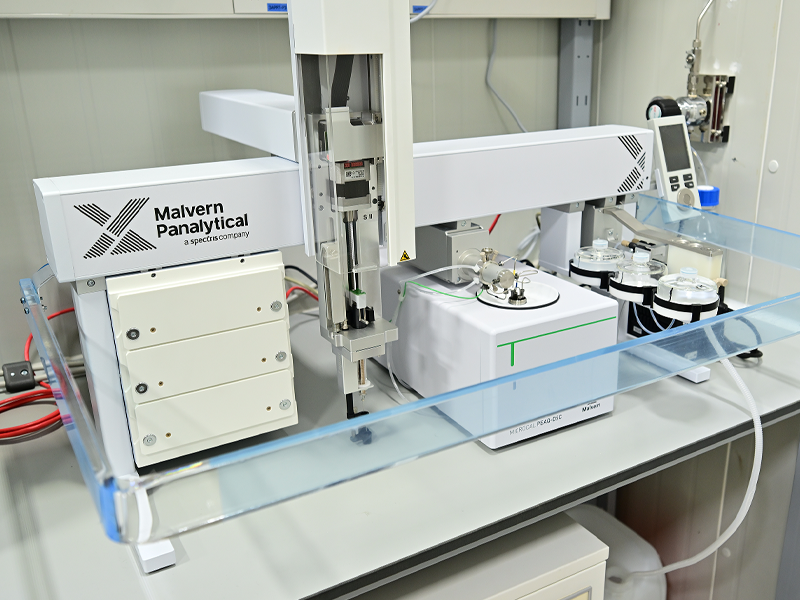
Differential Scanning Calorimetry

Differential Scanning Calorimetry

Brand:

Malvern

Model:

MicroCal PEAQ-DSC Automated

Affiliated Platform:

Sample Preparation and Analysis Core Facility

Placement:

Weiguang Life Science Park 1A Building 308

Contact Person:

Xie Xingqiao, Zhang Jing

Phone:

13671959351,15901507229

Email:

1. Calorimetric mode: power compensation mode

2. Noise level: Testing ribonuclease in passive feedback mode can be ≤0.05μcal/℃ (0.012μW)

3. Temperature scanning range: 2℃-130℃

4. Response time: No more than 5 seconds

5. Sample pool material: tantalum alloy material

6. Maximum scanning rate: not less than 240℃/ hour (4℃/ minute)

7. Sample pool design: capillary, fixed

8. Sample pool volume: no more than 130μl

9. Actual sample requirement: 325μl

10. Sample loading: 288 pieces

11. Sample cabin temperature control range: 4℃-40℃

12. Cooling scan: Yes

13. Measurement reproducibility: standard deviation of Tm value <0.08℃; ΔH relative standard deviation <2% (test ribonuclease)

14. Signal feedback mode: three signal feedback modes are optional; Passive, High gain, Low gain

15. With report designer and standard method editor

16. With local operation and maintenance video guidance

17. The binding constant analysis module is used to calculate the affinity KD

18. With automatic cleaning, sample module, automatic cleaning: with a fully automated robotic arm cleaning module, can realize the whole process of unmanned intervention, automatic, uninterrupted completion of deionized water, detergent, strong cleaning liquid and other conditions of automatic cleaning steps

19. A large number of parameters related to thermal stability can be obtained, including Tm value, Tonset, T1/2,△ Hcal,AHvan,△Cp and other parameters reflecting stability information from multiple angles.

Thermal differential scanning calorimetry (DSC) is to measure a large number of related parameters such as melting temperature (Tm) of polymer molecules such as biomolecules when the structure of protein is opened by 50% by scanning temperature, which can qualitatively and quantitatively obtain information such as thermal stability, structural homogeneity, and effective active concentration of biomolecules, so as to obtain a complete set of internal factors affecting the thermal stability of biomolecules and other polymers in one experiment.

Message