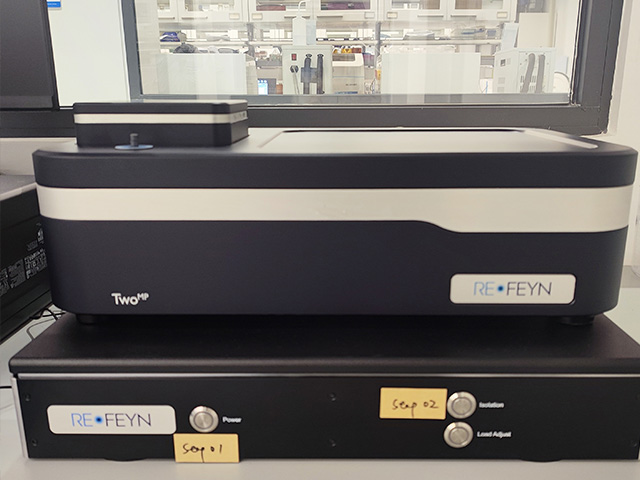
Mass photometer
Refeyn
Two MP
Sample Preparation and Analysis Core Facility
Weiguang Life Science Park 1A Building 308
Lin Xuezhen, Zhang Jing
15625063726,15019899679
linxuezhen@smart.org.cn,zhangjing@smart.org.cn

string(16) "en/equipment/780"
Welcome to SMART Core Facility
Refeyn
Two MP
Sample Preparation and Analysis Core Facility
Weiguang Life Science Park 1A Building 308
Lin Xuezhen, Zhang Jing
15625063726,15019899679
linxuezhen@smart.org.cn,zhangjing@smart.org.cn

1. Detect the molecular weight of biological macromolecules including proteins, antibodies, nucleic acids, polysaccharides, virus particles, etc. at single-molecule resolution.
2. No fluorescent labeling or immobilization required; directly measure interactions of molecules in their native state in solution.
3. Analyze biomolecular interactions at the single-molecule level, capable of simultaneously detecting molecular interactions involving protein monomers, dimers, and trimers in solution, and calculating the proportion of molecular subpopulations participating in the interaction.
4. Determine the binding ratio between antigens and the Fab fragment of antibodies, i.e., the proportion of antibody molecules binding to one or two antigen molecules.
5. Analyze the dynamic assembly process and stoichiometry of protein complexes.
6. Equipped with automatic laser focusing function; laser wavelength ≤ 488 nm.
7. Sampling frequency (standard setting): 1 kHz (raw), 100 Hz (integrated).
8. Single measurement accuracy: ±2% of the object's mass.
9. Single measurement mass error: 5% of the object's mass.
10. Single-molecule mass resolution (full width at half maximum): 25 kDa @ 66 kDa, 85 kDa @ 660 kDa.
11. Single-molecule mass sensitivity: ≤ 1 ng of protein.
12. Molecular weight measurement range: 30 kDa – 5 MDa.
13. Sample concentration range: 100 pM – 100 nM.
14. Single sample analysis time: ≤ 1 min.
Mass photometry technology directly and quantitatively measures the mass distribution and relative concentration of all substances in a sample. Applicable sample types include proteins, nucleic acids, and other biomolecules.