Multi-Omics Mass Spectrometry Core Facility
The Multi-Omics Mass Spectrometry Core Facility provides services for the identification, quantification, and in-depth characterization of biomolecules and drug molecules based on chromatography-mass spectrometry technologies. By integrating proteomics, metabolomics, lipidomics, pharmacokinetics, and other omics information, it supports researchers in gaining deeper insights into the molecular mechanisms underlying complex traits in physiological processes and diseases.
The core facility is currently equipped with 11 sets of large instruments and 8 sets of professional software.
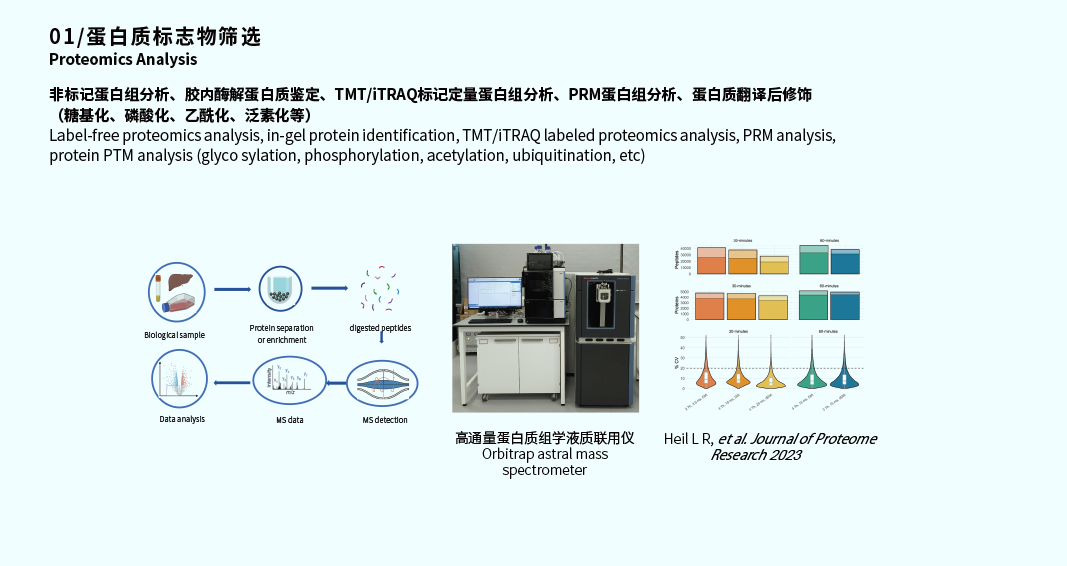
1)High�throughput proteomic LC�MS (Orbitrap Astral)
Suitable for protein biomarker screening. For a 200 ng 293F digest analyzed within 8 min, more than 7,000 proteins can be identified. Approximately 95% of proteins show a CV < 30% in triplicate instrumental runs.Applications include:
① Identification of protein–protein interactions using immunoprecipitation�mass spectrometry (IP�MS);
② Global analysis of protein expression and post�translational modification changes via perturbation proteomics following external stimuli (drugs, gene editing, etc.), to reveal the molecular mechanisms underlying functional alterations.
2)4D Omics LC�MS (timsUltra AIP)
Suitable for ultra�trace protein biomarker screening. For a 250 pg 293F digest analyzed within 30 min, about 4,000 proteins can be identified. Approximately 90% of proteins show a CV < 30% in triplicate instrumental runs.Applications include:
① Large�scale qualitative and quantitative analysis of immunopeptides using de novo sequencing;
② Single�cell proteomics to study heterogeneous expression in the tumor microenvironment or dynamic expression profiles during stem cell differentiation.
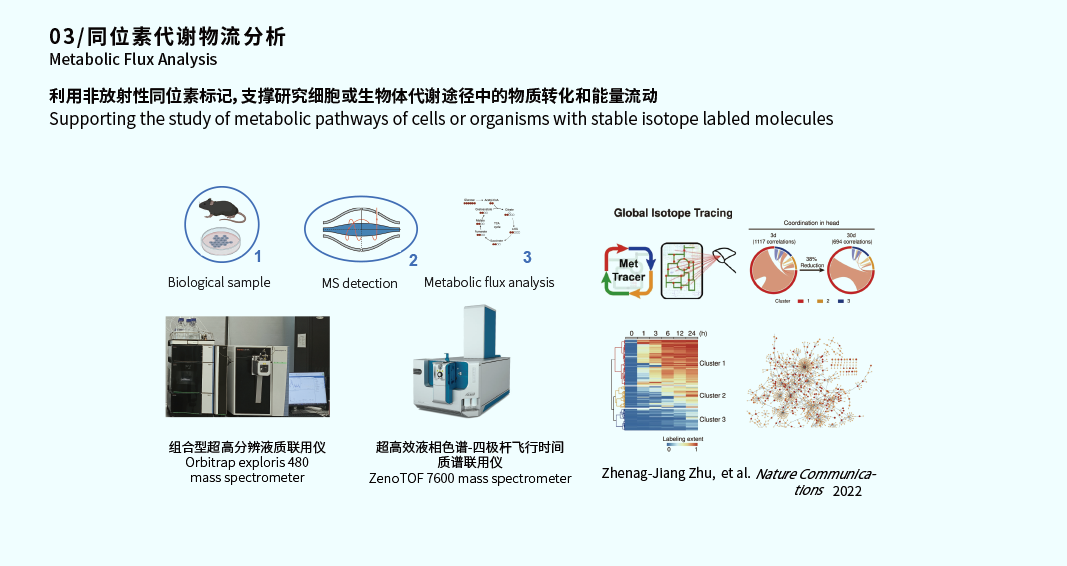
3)Quadrupole Time�of�Flight LC�MS (ZenoTOF 7600)
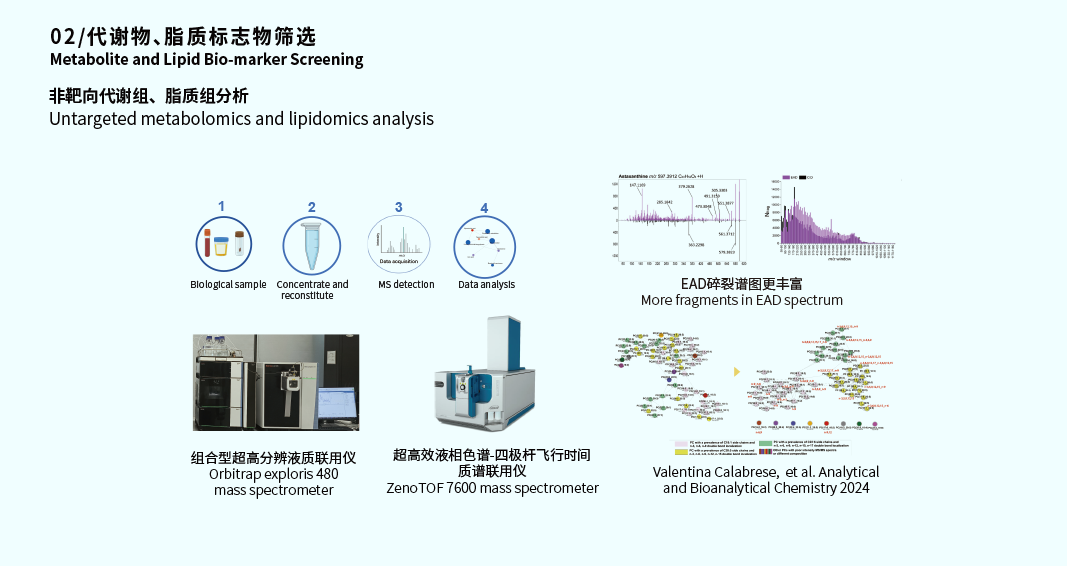
Used for untargeted metabolite biomarker screening. More than 2,200 metabolites can be identified in mouse plasma (false positives can be manually curated upon user request).Widely applied to metabolomic analysis of plasma, urine, exosomes, intracellular and extracellular metabolites. Also used for:
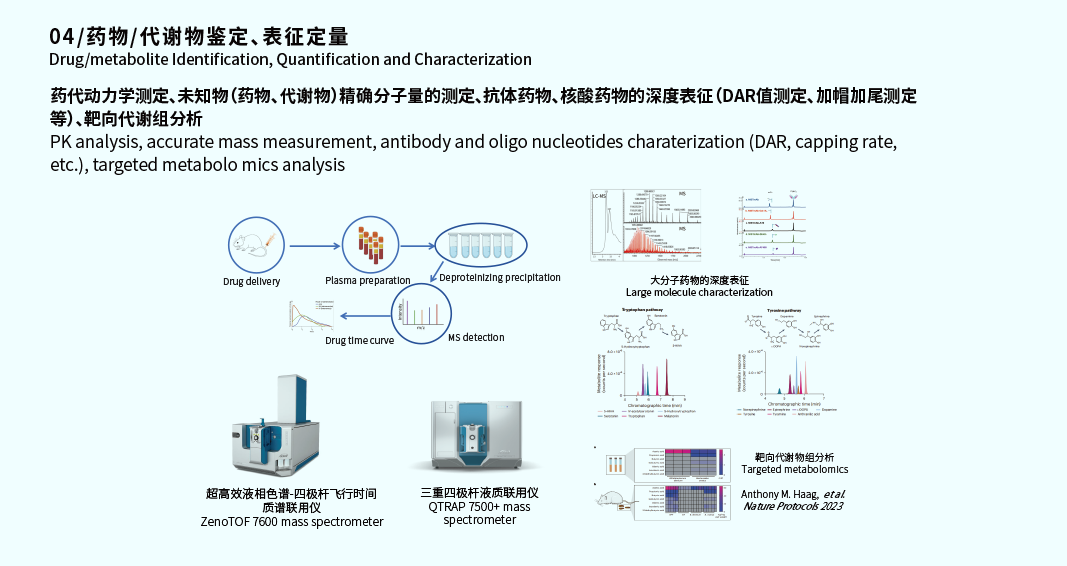
① Accurate molecular weight determination of unknown compounds (drugs, metabolites);
② Antibody�drug conjugate (ADC) DAR value measurement;
③ Capping and tailing analysis of nucleic acid drugs.
4)Hybrid High�Resolution LC�MS (Orbitrap Exploris 480)
Integrated with two types of liquid chromatography systems:
① Coupled with conventional UHPLC: for lipid biomarker screening, identifying more than 2,600 lipids in mouse plasma (false positives can be manually curated);
② Coupled with nano�LC: for glycoproteomics biomarker screening and characterization of complex post�translational modifications (glycosylation, methylation, acetylation, disulfide bonds, etc.).
5)Triple Quadrupole LC�MS (QTRAP 7500+)
Suitable for targeted quantification of metabolites and drug molecules, recognized as the gold standard for quantitative analysis, and commonly used for pharmacokinetic (PK) studies.
6)Thin�Layer MS (ExpressionL CMS) and Single Quadrupole LC�MS (LC/MSD)
Used for monitoring chemical synthesis reactions. Samples can be automatically extracted from TLC plates or directly spotted from powders/reaction solutions for molecular weight determination and synthesis yield evaluation.
7)Semi�preparative HPLC
Used for separation and purification of target compounds, equipped with UV/Vis and charged aerosol detectors (CAD) to meet diverse semi�preparative requirements.
8)Analytical HPLC
Used for component analysis and quantitation, equipped with UV/Vis, CAD, and fluorescence detectors for versatile analytical applications.
9)Professional Software
Includes Spectronaut for DIA proteomic data analysis, Proteome Discoverer for DDA proteomic data analysis, BioPharma Finder and Biologics Explorer for biopharmaceutical characterization, Peaks Studio for protein de novo sequencing, Peaks AB for antibody sequence assembly, MExplorer Ultimate for metabolomics, and LipidSearch for lipidomics.
A total of 23 full�process technical capabilities have been established, as listed in Table 2.1.
No. | Service Item | Large Instrument | Core Facility |
1 | Immunoprecipitation�based interactome proteomics | Orbitrap Astral | Multi�Omics Mass Spectrometry Core Facility |
2 | Plasma proteomics | Orbitrap Astral | Multi�Omics Mass Spectrometry Core Facility |
3 | Phosphoproteomics | Orbitrap Astral | Multi�Omics Mass Spectrometry Core Facility |
4 | Astral�DIA quantitative proteomics | Orbitrap Astral | Multi�Omics Mass Spectrometry Core Facility |
5 | PRM�based targeted protein quantification and validation | Orbitrap Astral | Multi�Omics Mass Spectrometry Core Facility |
6 | Immunopeptidomics | timsUltra AIP | Multi�Omics Mass Spectrometry Core Facility |
7 | 4D�DIA quantitative proteomics | timsUltra AIP | Multi�Omics Mass Spectrometry Core Facility |
8 | Protein identification from gel bands | Orbitrap Exploris 480 | Multi�Omics Mass Spectrometry Core Facility |
9 | Disulfide bond analysis | Orbitrap Exploris 480 | Multi�Omics Mass Spectrometry Core Facility |
10 | Antibody glycosylation characterization | Orbitrap Exploris 480 | Multi�Omics Mass Spectrometry Core Facility |
11 | Accurate molecular weight determination of small molecules | ZenoTOF 7600 | Multi�Omics Mass Spectrometry Core Facility |
12 | Intact protein molecular weight determination | ZenoTOF 7600 | Multi�Omics Mass Spectrometry Core Facility |
13 | Antibody-Drug Conjugate DAR value measurement | ZenoTOF 7600 | Multi�Omics Mass Spectrometry Core Facility |
14 | Nucleic acid drug capping and tailing efficiency | ZenoTOF 7600 | Multi�Omics Mass Spectrometry Core Facility |
15 | Untargeted metabolomics | ZenoTOF 7600 | Multi�Omics Mass Spectrometry Core Facility |
16 | Targeted metabolomics | QTRAP 7500+ | Multi�Omics Mass Spectrometry Core Facility |
17 | Untargeted lipidomics | Orbitrap Exploris 480 | Multi�Omics Mass Spectrometry Core Facility |
18 | Targeted lipid analysis | QTRAP 7500+ | Multi�Omics Mass Spectrometry Core Facility |
19 | Pharmacokinetic method development | ZenoTOF 7600 | Multi�Omics Mass Spectrometry Core Facility |
20 | Pharmacokinetic analysis | QTRAP 7500+ | Multi�Omics Mass Spectrometry Core Facility |
21 | Amino acid profiling (20 amino acids) | QTRAP 7500+ | Multi�Omics Mass Spectrometry Core Facility |
22 | Energy metabolism pathway analysis | QTRAP 7500+ | Multi�Omics Mass Spectrometry Core Facility |
23 | Catecholamine detection | QTRAP 7500+ | Multi�Omics Mass Spectrometry Core Facility |
Since its establishment, the platform has served about 60 research teams, completed more than 1,000 full�process technical services, and delivered over 300 experimental reports.The platform has been acknowledged in 2 published papers:
· Wang, Y. et al. Global profiling of arginine reactivity and ligandability in the human proteome. Nature Chemistry, 2025. This study used the SCIEX QTRAP 7500+ small�molecule quantification platform to measure intracellular dynamic levels of synthetic small molecules with protein modification activity.
· Tang, X. et al. Evolutionary repurposing of a metabolic thiolase complex enables antibiotic biosynthesis. Nature Communications, 2026. This study used the Orbitrap 480 high�resolution LC�MS for protein modification analysis, enabling the identification of acetylation modifications.
The core facility has developed the SmartTube method, which automates in�gel digestion, decolorization, and peptide extraction, reducing labor input by 80%. Tests show that protein coverage from 50 ng to 5 μg samples processed via SmartTube is consistent with manual extraction.
Current R&D priorities:
1) High�throughput sample preparation to improve service throughput and solve bottlenecks in low amount sample pretreatment;
2) Optimization of detergent�containing sample pretreatment to simplify workflows and improve compatibility with diverse sample types;
3) Single�cell omics technologies to meet the demand for single�cell analysis from research groups.
 Return to Main Site
 Search
 中文
中文



 中文
中文
 Home
Home


 15999620832
 hdyin@smart.org.cn
 深圳市光明区卫光生命科学园1A栋四层


 Message